
Terminology of the Storytelling Boom
The shared vocabulary of the storytelling boom.
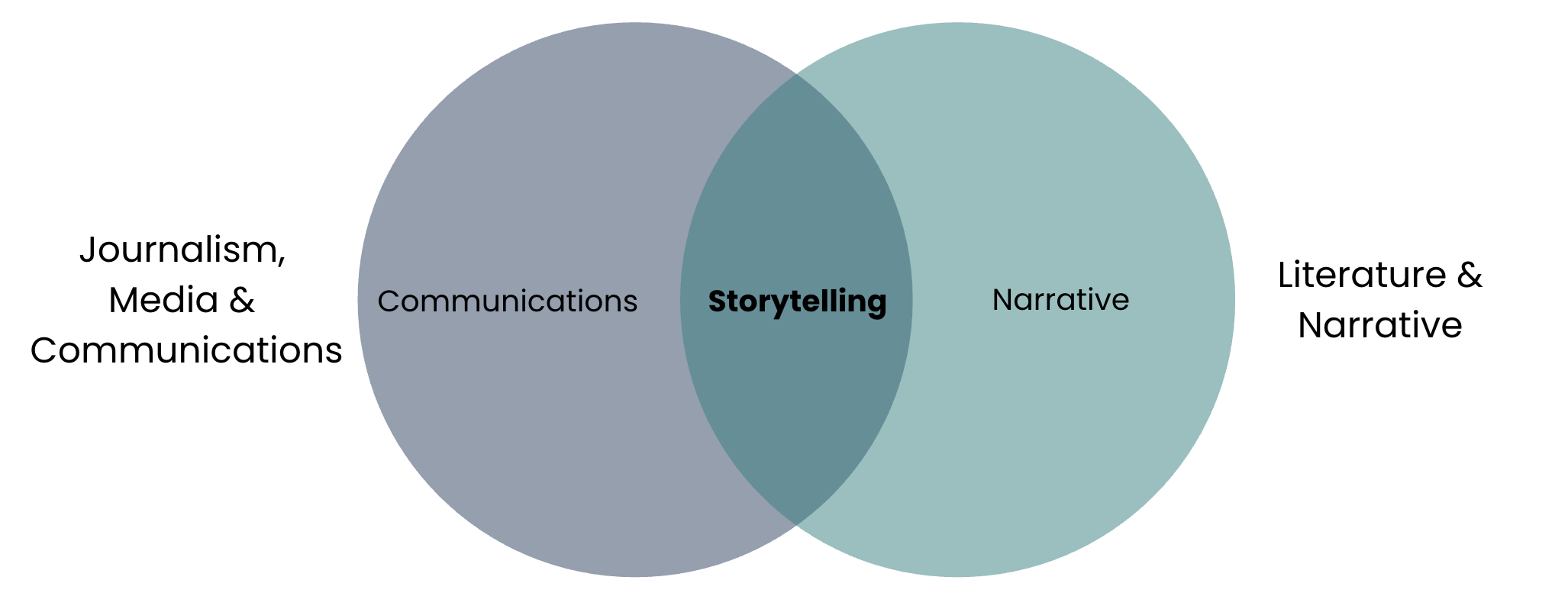
While the storytelling boom is firmly located within communications practice, the study of stories is located within the study of literature — as a result, the vocabulary is a combination of terms that are not used universally throughout the storytelling boom.
As a rule of thumb:
People who study stories are most interested in the text itself, and typically use terms from Journalism, Media & Communications studies.
People who produce stories are most interested in the opinions expressed in the texts, and typically use terms from Journalism, Media & Communications studies.
This Shared Vocabulary lists the terms that are not universally used — with their equivalent terms, or alternate meanings:
Terms used by those who produce stories, originating from studies in Journalism, Media and Communications — and the equivalent used by those who study stories.
Terms used by those who study stories, originating from studies in Literature and Narrative Theory — and the equivalent used by those who produce stories.
Terms used by both those who produce and study stories — but used differently (indicated in bold).
The Glossary of Terms lists definitions offered by others.
Vocabulary
Content
Ethics (same word, different meaning)
Ethical storytelling
Impact storytelling
Corporate storytelling
Narrative change
Narrative landscape
Narrative literacy
Narrative power
Narrative research (same word, different meanings)
Narrative strategy
Narrative theory
Narratology
Story (same word, different meanings)
Storytelling boom
Organizational storytelling
Strategic storytelling
Instrumentalized storytelling
Media narrative
Messaging
Narrative (same word, different meaning)
Narrative Theory
Equivalent: “text”.
Stories narrated by a corporation.
(While this is a descriptor of a communications practice, the term is mostly used in academia.)
“Ethics” in narrative study usually refers to ethical issues relating to a narrative text, such as its impact on the subject or the reader.
Narrative scholars usually critique a text without insight into the process collecting and telling the story, so they typically don’t reference this process.
Equivalent: “instrumentalized storytelling”.
Personal stories that are used by an organization or corporation as an instrument — usually of a strategic campaign.
Equivalent: if referenced, probably referenced as “master narrative”.
Equivalent: “rhetoric”
Generally refers to a type of text — with a beginning, middle and end — that gives an account of events from a specific point of view e.g. a “narrative text”. Also refers to the techniques and devices employed within the text to create audience effect.
(Not used, although master narratives and counter-narratives might be equivalent.)
The skill of being able to “read” the structure and parts of a narrative.
(Not used — however narrative scholars might reference the “power” of narrative when describing the impact of a narrative text.)
Collecting narrative texts as data, usually through interviews.
(Not used.)
The study of narrative texts and theories about how they work.
The study of narrative texts and how they are used.
Stories narrated by an organization.
Most commonly refers to a narrative text; often used interchangeably with “narrative”.
The dramatic rise in storytelling as a form of communication — particularly persuasion. (Also referred to as "the storytelling turn”.)
(Equivalent: “corporate storytelling”, “organizational storytelling” or “instrumentalized storytelling”.)
“Ethics” in practice usually refers to the factual correctness of a text i.e. whether the facts in the text can be independently verified.
A communications practice or method of telling stories about real people who benefitted from a nonprofit or NGO’s work, without causing harm to the people whose stories are told.
Stories told by a nonprofit, NGO or social change organization to describe the human impact of that organization’s work.
Note: "Instrumentalized storytelling” isn’t a term used in professional communications because stories are only produced for instrumentalization.
The dominant (or most common) point of view of an event as narrated by media publications, most commonly news publications.
The point of view of a public figure (or organization), communicated through spokespeople and public communications. Often used interchangeably with “narrative”.
The most common usage is describing a point of view. For example, the “narrative” of an organization would be that organization’s point of view on the issues it is concerned with.
The work of persuading public opinion on a social issue. Learn more.
Mapping and measuring the opinions of the public and media on a social issue.
(Not used.)
Political power gained by influencing public opinion through storytelling.
Public opinion research, typically collected through surveys. (Example)
Interchangeable with “narrative change”.
(Not used.)
(Not used.)
(Equivalent: “strategic storytelling” or “impact storytelling”.)
A published article (or “piece”) published by the media.
(Not used.)
The practice of telling stories as a tactic, e.g. a PR strategy or marketing strategy. Learn more.
Communications
The written text, video and images published in a communications product such as a social media post, webpage or op ed.
In practice, corporate communications is usually just called “strategic storytelling” or “comms”.
Glossary of Terms
Content marketing
Ethics
Ethical storytelling
Impact storytelling
Narrative change
Narrative landscape
Narrative literacy
Narrative power
Narrative research
Narrative strategy
Narrative theory
Narratology
Story
Definitions from Communications Practitioners
Organizational storytelling
Narrative
Stories narrated by an organization. Learn more.
“Ethical storytelling is a practice within impact storytelling that adheres to policies and practices introduced to prevent harm caused by the impact of the story collection or telling (publication) processes. —” — Fiona J. Ramsey, No Lip Service.
“…’impact storytelling’ — defined as intentional, strategic storytelling designed to advance social impact goals.” — Spotlight on Impact Storytelling, p. 4.
“Impact storytelling is the communications practice of telling stories about real people — narrated by an organization — that describe the human impact of that organization’s work, for the benefit of that organization.” — Fiona J Ramsey, No Lip Service.
“Narratives are the ideas and themes that permeate collections of stories. The ideas can appear in any structure, and are articulated and refined repeatedly in a variety of stories and messages.” — Narrative Initiative
“Narratives are systems of stories that shape our attitudes and behaviors and help us make meaning of the world around us.” — The Math Narrative Project
“Narratives (are) collections of stories circulating within a society that convey themes, frames, and worldviews that are collectively recognized, understood, and embraced by its members.” — BLIS Collective
“A narrative consists of a collection or body of stories which together convey a common worldview or meaning — an interpretation of the world and how it works.” The Narrative Directory.
“Narratives are sets or patterns of stories that contain beliefs about the way the world works. They provide meaning and a lens through which to intepret issues, causes, and life events.” ORS Impact
“Narratives are patterns of stories that are held by individuals or groups and contain beliefs about the way the world works. They can be harmful, beneficial, or a mixture.” Liz Manne Strategy
“Narrative change is an effort to counter, modify, or replace existing narratives by creating and deploying new or different narratives.” — The Math Narrative Project
“Narrative change rests on the premise that reality is socially constructed through narrative, and that in order to bring about change in the world we need to pay attention to the ways in which this change takes place.” — The Narrative Directory.
“Narrative change is a change in the narratives that circulate within public discourse: either in the set of narratives in circulation (ie. which narratives are used) or in their relative prevalence (i.e. which narraties re used more or less frequently), or both.” ORS Impact
“A narrative landscape is a map of the harmful and helpful narratives that affect how people think about, talk about, and make decisions about your cause.” — Narrative Initiative
“narrative literacy is the capacity to emplot a sequence of events into a rounded whole, and to understand others doing so.” Moenander, Alber and Thirlway
“The storying of experiences.” — Christina Romero-Ivanova, Tara Kingsley and Lance Mason.
“Understanding how stories function and their effects at individual and collective levels” Sarah Dillon and Claire Craig in Storylistening.
“Narrative power refers to the ability to shape and control the stories told within a society, including which ones are told, who tells them, and how they are interpreted.” — Shanelle Matthews and Marzena Zukowska
“The ability to tell stories that shift the mental models and cultural mindsets that define our cultural norms.” — The Narrative Directory
“Narrative research is the study of circulating stories, where they come from, how they spread and coalesce, and how they impact public sentiment, policy, and broader culture. Applied narrative research encompasses all of this, with the crucial addition that it is designed, from start to finish, to serve movement strategy, with the ultimate goal of deepening collective power.” — BLIS Collective
“Narrative strategy is the practice of sharing connected stories to forge, spread, and reinforce beneficial narratives and counter harmful ones.” — Liz Manne
“Narrative theory starts from the assumption that narrative is a basic human strategy for coming to terms with fundamental elements of our experience, such as time, process, and change, and it proceeds from this assumption to study the distinctive nature of narrative and its various structures, elements, uses, and effects.” — Project Narrative.
“Narratology is a humanities discipline dedicated to the study of the logic, principles, and practices of narrative representation.” — the living handbook of narratology
“Narratology is the study of the form and functioning of narrative.” Gerald Prince.
My Story, Your Narrative: Scholarly Terms and Popular Usage in The Routledge Companion to Narrative Theory discusses the change in use of “story”.
“A story describes an event or sequence of events that include characters, conflict, and imagery. It has a beginning, middle and end.” — Narrative Initiative
“Stories consist of characters, joined in some common problem in a temporal trajectory (plot) leading towards resolution within a particular setting or context.” — The Narrative Directory
“Stories are an essential part of how we process, understand and interpret our life experiences.” ORS Impact
Definitions from Narrative Scholars
“‘Content marketing’ is a general term used to refer to the marketing communications tactic of sharing useful and valuable content — texts, films, audio — for the purpose of promoting a particular organization, product or individual to a specific audience.” Cecilia Thirlway
“Narrative ethics explores the intersections between the domain of stories and storytelling and that of moral values.” — Living Handbook of Narratology
“narrative ethics is in itself an interdisciplinary area of research, most commonly understood either as a subfield of narrative studies or as a particular approach to ethics.” Hanna Meretoja.
“It is both the charm and the challenge of narrative that no one discipline can define precisely what it is or does, though surely each contributes to our understanding. Some scholars – narratologists, for instance – study the structures of stories in and of themselves. Others analyze specific narratives according to established methodologies, from the literary scholar’s “close reading” to the sociologist’s discourse analysis. Some, such as qualitative researchers, look at narrative as a form of data; for others, it is an approach to interpreting such data.” Centre for Interdisciplinary Research on Narrative
“Narrative… may be defined as the representation of real or fictive events or situations in a time sequence.” Gerald Prince.
“The representation (as product and process, object and act, structure and structuration) of one or more real or fictive events communicated by one, two, or several (more or less overt) narrators to one, two, or several (more or less overt) narratees.” Gerald Prince.
My Story, Your Narrative: Scholarly Terms and Popular Usage in The Routledge Companion to Narrative Theory discusses the change in use of “narrative”.
Other References
Online Glossaries
Reference Books
Living Glossary of Digital Narrative
Published by the Centre for Digital Narrative.
Living Handbook of Narratology
Based on the Handbook of Narratology.
No Lip Service Glossary
Key terms at the intersection of communications and narrative.
The Narrative Directory
Key Terms used across the narrative change ecosystem.
Dictionary of Narratology by Gerald Prince
Routledge Encyclopedia of Narrative Theory Edited by David Herman, Manfred Jahn and Marie-Laure Ryan
The Cambridge Introduction to Narrative by H. Porter Abbott
The Routledge Companion to Narrative Theory Edited by Paul Dawson and Maria Mäkelä